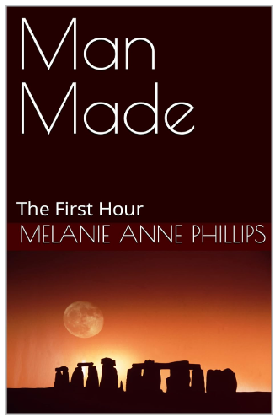
Read the Science Fiction Thriller
From the founder of Storymind
Man Made follows a mysterious force as it sweeps around the globe erasing anything man made - from buildings, vehicles, and technology to medicines, clothing, and dental work.
Governments stagger under the panic, religions are at a loss for an explanation, scientists strive for any means to stop or divert the phenomenon, and the world’s population from families to individuals struggle to prepare for The Event, which will drive humanity back beyond the stone age.
The Event is coming.
Are you prepared?
How does the construction of scenes relate to Dramatica’s story elements?
The concept is that a complete "scene" in structural terms is a "complete dramatic movement." In other words, there must be a Potential, Resistance, Current, and Outcome (or Power) regarding a single issue to complete a scene.
In this way, we might think of each scene as a single dramatic "circuit." Although it has "flow" a circuit is really seen as a unit, comprised of these four parts. Therefore, we do not necessarily have to start by setting up a Potential and then introducing a Resistance. Rather, we might start with a Resistance ( a brick wall, for example) and then introduce the Potential (a herd of galloping wild horses.)
The order in which these elements of a scene need to be introduced is not merely storytelling. In fact, there is a specific structural order to it which is determined by the meaning or impact you wish to instill in your audience. This can be understood by realizing that if we take two events from a scene, say a slap and a scream, then we find that a slap followed by a scream has a completely different meaning than a scream followed by a slap. In the first case (depending upon context) it might mean a slap was struck in anger leading to a scream in response from the pain or emotional hurt. But, a scream might begin the scene, indicating perhaps hysteria, in which case the slap would THEN be applied out of concern or "tough love" to bring the person to his or her senses,
The Dramatica Story Engine actually predicts the order (1,2,3,4) and nature (P,R,C,O) of every element in every quad in the entire structure, based on the impact you have indicated by making storyform choices. But, the data is so extensive that it takes several hundred pages to print it all out.
We determined that this flood of information would drown authors in a sea of numbers, far away from the intuitive sense of writing. And, what’s more, it is SO specific that we thought it might lead to "writing by the numbers." The biggest tragedy would be that the audience is not really concerned with that degree of detail so much, and really tends to "give" that to the author, even if it is out of order, as long as all the pieces are there somewhere. So, why worry about being that accurate when it has so little importance in the grand scheme of things?
As a result, this information, though generated by the engine in every storyform, has no means of extraction from the software at this time.
One more bit of information, the "spiral" nature of the structure (recently described with insight by Armando) is such that the Type (Plot) level of the structure determines the dramatic circuits of ACTS, the Variation (Theme) level determines the dramatic circuits of SEQUENCES, the Element (Character) level determines the dramatic circuits from one SCENE to the next, and the spiral effect takes us back to the top Class (Genre) level which determines the dramatic circuits of the EVENTS within each Scene.
So, each Event in a Scene will have a 1,2,3,4 for sequential order, a P,R,C,O, for context, and be a Situation (Universe), Attitude (Mind), Activity (Physics), and Mentality (Psychology).
In other words, the four required Events for every complete dramatic movement at the Scene level will be something Situational, Attitude illustrative, Active, and exhibiting Mentality.
Structural Scenes illustrate these four Events in terms of Character, Plot, Theme, and Genre (no direct correlation here.) Storytelling Scenes illustrate these four Events in terms of audience impact (impacting the audience’s sense of their own Situation, affecting their Attitude, involving them in a vicarious Activity, or exploring the way their minds run by illuminating the Mentality.
Both Structural and Storytelling Scenes can be presented in Active or Passive fashion. Passive Scenes illustrate these Events in the Story or Audience. Active Scenes put them into motion, moving the story forward or invoking changes in the nature of the audience itself.