|
 |
 |
 |
 |
 |
 |
 |
|
|
|
|
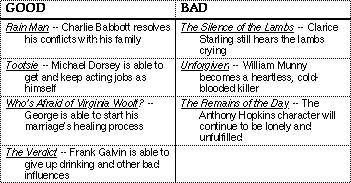
8. Main Character Judgment: Good or Bad?As an author, you can temper the story's Outcome by providing a Judgment as to whether the Main Character resolves his personal angst or not. Regardless of Success or Failure in the effort to achieve the goal, is your Main Character able to resolve his personal angst? If so, choose Good, and if not, choose Bad. The notion that the good guys win and the bad guys lose is not always true. In stories, as in life, we often see very bad people doing very well for themselves (if not for others). And even more often, we see very good people striking out. If we only judged results by success and failure, it wouldn't matter if the outcome was Good or Bad as long as it was accomplished. The choice of Good or Bad tempers the story's success or failure by showing whether the Main Character resolves his personal problems or not. The Story Judgment provides you with an opportunity to address good guys that win and bad guys that fail, as well as good guys that fail and the bad guys that win. It also allows you to comment on the success or failure of your characters' growth as human beings. An example of a story where a Main Character's personal problem -- finding inner peace -- remains unresolved at the end is The Silence of the Lambs. The abduction of the Senator's daughter initiates the Overall Story so her rescue provides its resolution. But Clarice's personal problem -- her recurring nightmares of lambs crying as they're being slaughtered -- is emphasized as she plays "cat and mouse" with Dr. Lecter. When he asks her in the end whether "the lambs are still crying," it is clear by her silence that they are. She will not be at peace until she releases her need to save innocents, so the story ends with a Bad feeling even though the Overall Story is successful and her future as an FBI agent seems bright. This juxtaposition creates a bittersweet ending which is further emphasized by the somber music playing over the final shots. In contrast, Charlie Babbott (played by Tom Cruise) in Rain Man is seeking to collect an inheritance left by his wealthy father to the autistic brother he's never met. When Raymond (Dustin Hoffman) turns out to be a "idiot savant" in mathematics, able to memorize an entire phone book and "count cards," Charlie schleps him to Las Vegas. There he hopes Raymond will make him some fast cash to save his failing business although Charlie's girlfriend's protests and ultimately rejects him as he uses Raymond for selfish means. Along the way, however, depth of feeling Charlie discovers for his long-lost brother surprises and changes him. At the end, Charlie is forced to return Raymond to the hospital where he can be cared for properly, but it is clear to the audience that the bond Charlie feels for Raymond is real when he promises to visit Raymond. He has gained both family and self-respect through their journey so although Charlie fails to get the inheritance at the end, what he has gained personally outweighs what he has lost financially. As the story fades out, it is clear the author judges this Failure/Good to be positive and the audience feels hopeful for Charlie even though his money problems remain unresolved. Examples of Good and Bad:
*Try either or both for 90 days. Not working for you? Return for a full refund of your purchase price!
|
|
|
Contact Us - About Us - Lowest Price Guarantee - Shipping - Return Policy Copyright Melanie Anne Phillips - Owner, Storymind.com, Creator Storyweaver, Co-creator Dramatica |