|
 |
 |
 |
 |
 |
 |
 |
|
|
|
|
Dramatica Writing Tips Writing Characters of the Opposite Sex Writing Characters of the Opposite Sex Perhaps the most fundamental error made by authors, whether novice or experienced, is that all their characters, male and female, tend to reflect the gender of the author. This is hardly surprising, since recent research finally proves that men and women use their brains in different ways. So how can an author overcome this gap to write character of the opposite sex that are both accurate and believable to their own gender? In this Dramatica Tip, we’ll explore the nature of male and female minds and provide techniques for crafting characters that are true to their gender. But first, Storymind.com is pleased to announce a new 3-hour program available on audio CD or audio cassette that fully explores “Writing Characters of the Opposite Sex.” Presented by the co-creators of the Dramatica theory and software, this program explains the biologic and learned differences in the minds of men and women and offers step-by-step descriptions of the thought patterns, manners of expression, and means of manipulation of each sex within themselves and when relating to other of the same and opposite sexes. For more information visit http://store.yahoo.com/dramatica/writcharofop.html At first, it might seem that being male or female is an easily definable thing, and therefore easy to convey in one’s writing. But as we all know, the differences between the sexes have historically been a mysterious quality, easily felt, but in fact quite hard to define. This is because what makes a mind male or female is not just one thing, but several. First, let’s consider that gender has four principal components: Anatomical Sex Sexual Preference Gender Identity Mental Sex Anatomical sex describes the physicality of a character – male or female. Now, we all know that people actually fall in a range – more or less hairy, wider or narrower hips, deeper or higher voice, and so on. So although there is a fairly clear dividing line between male and female anatomically, secondary sexual characteristics actually create a range of physicality between the two. Intentionally choosing these attributes for your characters can make them far less stereotypical as men and women. Sexual Preferences may be for the same sex, the opposite sex, both, or neither (or self). Although people usually define themselves as being straight, gay, bi, or celibate, this is also not a fixed quality. Statistics show, for example, that 1/3 of all men have a homosexual encounter at least once in their lives. Although it often stirs up controversy to say so, in truth most people have passing attractions to the same sex, be it a very pretty boy or a “butch” woman. Consider the sexual preference of your characters not as a fixed choice of one thing or another, but as a fluid quality that may shift over time or in a particular exceptional context. Gender Identity describes where one falls on the scale between masculine and feminine. This, of course, is also context dependent. For example, when one is in the woods, at home with one’s family, or being chewed out by the boss. Gender Identity is not just how one feels or things of oneself, but also how one acts, how one uses one’s voice, and how one wishes to be treated. Often, a male character may have gentle feelings but cover them up by overly masculine mannerisms. Or, a female character may be “all-business” in the workplace out of necessity, but wish someone would treat her with softness and kindness. Actuaally, Gender Identity is made up of how one acts or wishes to act, and how one is treated or wishes to be treated. How many times have we seen a character who is forced by others to play a role that is in conflict with his or her internal gender self-image? Gender Identity is where one can explore the greatest nuance in creating non-stereotypical characters. Finally, Mental Sex describes where one falls on the scale from practical, binary, linear, logistic, goal-oriented thinking to passionate, flexible, emotional, process-oriented thinking. In fact, every human being engages in ALL of these approaches to life, just at different times and in different ways. Now, in creating characters, consider that each of the four categories we just explored is not a simple choice between one thing or another, but a sliding scale (like Anatomical Sex) or a conglomerate of individual traits (like Gender Identity). Then, visualize that wherever a character falls in any one of those four categories places absolutely no limits on where he or she may fall in the other categories. For example, you might have a character extremely toward male anatomical sex, bi-sexual (but leaning toward a straight relationship at the moment), whose gender identity is rough and tumble ( but yearns to be accepted for his secret sensitivity toward impressionistic paintings) who is practical all the time (except when it comes to sports cars). Any combination goes. But when it comes to Mental Sex itself, there are four sub-categories within that area alone which tend to define the different personality types we encounter: Subconscious Memory Conscious Preconscious In brief, each of these “levels” or “attributes” of the mind can lean toward seeing the world in definable or experiential terms. Pre-conscious is a tendency to perceive the world in components or as processes that is determined before birth. It is the foundation of leaning toward the tradition “male” or “female” personality traits. Subconscious determines the tendencies we have to be attracted or repelled from component or process rewards. Memory relies on our training to organize our considerations in a give situation toward components or processes. And every character always has a Conscious choice to focus on the components or processes at any given moment. In other words, in a given situation, at each level of Mental Sex does a character center on the way things are or the way things are going? At each level is the character more interested in getting his or her ducks in a row or in a pond? Finally, beyond all of these considerations is the cultural indoctrination we all receive that leads us to respond within social expectations appropriately to the role associated with our anatomical sex. These roles are fairly rigid and include what is proper to wear, who speaks first, who opens the door or order the wine, who has to pretend to be inept where and skilled where else (regardless of real ability or lack there of in that area), the form of grammar one uses in constructing sentences, the words one is expected to use (“I’ll take a hamburger,” vs. “I’d like a salad”), and the demeanor allowable in social interaction with the same and the opposite sex, among many other qualities. In the end, writing characters of the opposite sex requires a commitment to understand the difference between those qualities which are inherent and those which are learned, and to accept that we are all made of the same clay, but just sculpt it in different ways. For more depth and detail, consider the 3-hour program “Writing Characters of the Opposite Sex,” available on audio CD or audio cassette at http://store.yahoo.com/dramatica/writcharofop.html Melanie Anne Phillips Visit the Dramatica Theory Home Page 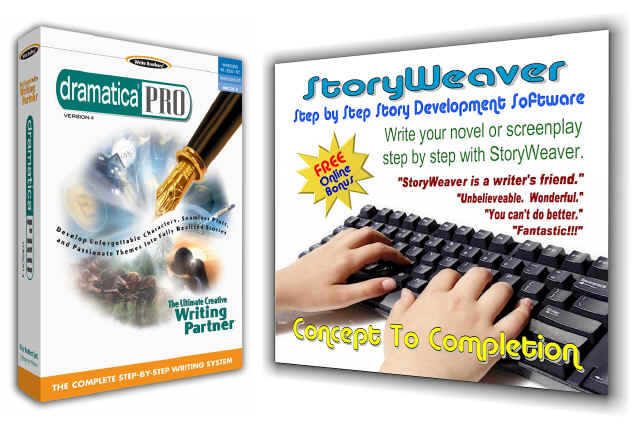 $179.95 $29.95 *Try either or both for 90 days. Not working for you? Return for a full refund of your purchase price! About Dramatica and StoryWeaver Hi, I'm Melanie Anne Phillips, creator of StoryWeaver, co-creator of Dramatica and owner of Storymind.com. If you have a moment, I'd like to tell you about these two story development tools - what each is designed to do, how each works alone on a different part of story development and how they can be used together to cover the entire process from concept to completion of your novel or screenplay. What They Do Dramatica is a tool to help you build a perfect story structure. StoryWeaver is a tool to help you build your story's world. Dramatica focuses on the underlying logic of your story, making sure there are no holes or inconsistencies. StoryWeaver focuses on the creative process, boosting your inspiration and guiding it to add depth, detail and passion to your story. How They Do It Dramatica has the world's only patented interactive Story Engine™ which cross-references your answers to questions about your dramatic intent, then finds any weaknesses in your structure and even suggests the best ways to strengthen them. StoryWeaver uses a revolutionary new creative format as you follow more than 200 Story Cards™ step by step through the story development process. You'll design the people who'll inhabit your story's world, what happens to them, and what it all means. How They Work Together By itself Dramatic appeals to structural writers who like to work out all the details of their stories logically before they write a word. By itself, StoryWeaver appeals to intuitive writers who like to follow their Muse and develop their stories as they go. But, the finished work of a structural writer can often lack passion, which is where StoryWeaver can help. And the finished work of an intuitive writer can often lack direction, which is where Dramatica can help. So, while each kind of writer will find one program or the other the most initially appealing, both kinds of writers can benefit from both programs. Try Both Programs Risk Free! We have a 90 Day Return Policy here at Storymind. Try either or both of these products and if you aren't completely satisfied we'll cheerfully refund your purchase price.
Our Complete Catalog of Products
|
| ||||||||||||||||||||||||||||||||||||||||||||||||||||||||||||||
|
Contact Us - About Us - Lowest Price Guarantee - Shipping - Return Policy Copyright Melanie Anne Phillips - Owner, Storymind.com, Creator Storyweaver, Co-creator Dramatica |











 Format:
Windows / Mac CD-ROM
Format:
Windows / Mac CD-ROM