|
|
Software |
StoryWeaver
$29.95

A step by
step approach to story development, from concept to completed story for
your novel or screenplay. More than 200 interactive Story Cards guide
you through the entire process.
Details
and Demo
Dramatica
$149.95

The most
powerful story structuring software available, Dramatica is driven by a
patented "Story Engine" that cross-references your dramatic
choices to ensure a perfect structure.
Details
and Demo
Movie
Magic Screenwriter
$149.95

The most
advanced screenwriting software available, Movie Magic is deemed a
"preferred file format" by the Writer's Guild. An industry
standard, MMS is used by professionals and studios around the world.
Details
and Demo
Throughline
Index Cards
$9.95

Interactive
index cards - Name them, add notes, titles, colors, click and drag to
re-arrange, adjust font, save, export and print. An essential tool for
every writer.
Details
Academic
Discounts
on Select Products

Are you a
student, teacher, or academic staffer? Get the very best price on select
products with these manufacturer sponsored academic discounts!
Details

|
| |
Constructive Criticism:
THE XX AND XY FILES
Written by
Melanie Anne Phillips
Based on the Dramatica theory of story
originally developed by
Melanie Anne Phillips
and Chris Huntley
What is it about The X-Files that has attracted such a following?
Is it the blend of New Age philosophy and hard science fiction? Could it be the taboo
subjects or government conspiracies? How about the flashy production values and high-tech
special effects?
Naturally, all of these contribute to the phenomenal success of the show, but they don't
fully explain the unusual "feel" of the program. Anyone who has seen the series
knows what we mean. There is a strange emotional aura experienced by the viewing audience
that is almost metaphysical itself. In fact, tracking down the source of this strange
atmosphere could be a case right out of The X-Files themselves.
Fortunately, as the opening credits assert: "The truth is out there." In this
case, Dramatica can help illuminate it.
To begin our investigation, let's look to our intrepid agents, Mulder and Scully. Who are
they? FBI agents, of course. But we asked who they were, notwhat. For our inquiry,
we are more interested in their natures than their functions. It is not that they unravel
the tangled, clarify the obscure, and defeat the random. Oh, they do all of that all
right, but that's just plot. We are more interested in how they accomplish these
ultra-human feats, not their methodology but their mentality.
Who are theyinside? What makes them tick? What do Mulder and Scully have in common
that makes them uncommon? The answer lies in the Dramatica concept called Mental Sex .
Mental Sex has two options: male or female. It has nothing to do with anatomical sex,
gender identity, or sexual preference. Mental Sex refers to the mind of a character as
being either spatially (space) or temporally (time) biased. Space is where our sense of
logistics comes from. Time is where our intuition comes from. Male Mental Sex sees
logistics clearly, but is a little fuzzy on the intuition. Female Mental Sex is intuitive,
but not as clear on the logistics.
Of course, males can be intuitive and females logical, but it requires a little extra
work. Also, intuition is not inexact. It seems so to men, because it is a fuzzy logic to
them. But to women, intuition is perfectly clear: a form of holistic logic of its own that
deals with problems by the "inter-influences" of the many parts, rather than
trying to find a direct path from problem to solution.
For the most part, authors create characters who have the same Mental Sex as their
anatomical sex. Occasionally, through intent or feel, these two get mixed up. For example,
Ripley (Sigourney Weaver) in the original Alien was a male mental sex
character. The part was actually written for a man; all they changed were the gender
references. Her manner of approaching a problem was male right down the line. In contrast,
Tom Wingo (Nick Nolte) in The Prince of Tides is a female mental sex
character who tries to bring his life into balance: a holistic technique.
Just because a physically male character has a female mental sex does not mean they will
be feminine. An example is Jack Ryan (Alec Baldwin) in The Hunt For Red October.
Notice how his problem solving technique is quite different than that of all the generals
and soldiers he is competing against, yet he is unquestionably masculine.
The difference in Jack Ryan's manner is easily recognized in his meeting with the chiefs
of staff near the beginning of the story. While they are concentrating on how to respond
to the threat, Ryan is feeling the influence of many bits of information. Though this data
seems unrelated, its overall impact on his mind allows him to surmise that the wayward
Russian captain is not attacking but defecting. Only a female mental sex character would
arrive at that kind of solution from that kind of data.
So...what is the strange attraction of Mulder and Scully in The X-Files?
Mulder is a man with a female mental sex; Scully is a woman with a male mental sex. While
Mulder is getting a feeling or being intuitive, Scully demands facts, measurements, and a
linear theory without gaps. In most episodes, both methods are required to uncover the
mystery. Though this is not uncommon in real life, switching mental sexes is atypical of
most television fare.
The charm of the show is partly because the kinds of problems that occur could not be
solved by either one of them alone, but truly needs both views to triangulate. Mulder gets
a sense of what's going on; Scully describes it. Scully projects where things are leading,
Mulder determines what it means. Since we are talking about a series rather than one
specific story, things do change.
In some episodes, Scully is also made female mental sex. In these programs, Scully becomes
a simple skeptic instead of an alternate problem solving perspective. This weakens Scully
and Mulder's relationship. Mulder is still female mental sex, but he cannot explore that
perspective since he has to spend all his time trying to overcome Scully's skepticism.
Scully keeps demanding proof instead of working out a theory. Under these conditions the
show still has its conspiracies, new-age sci-fi, and special effects, but the heart stops
beating. That special something is clearly missing, but in episodes where Scully returns
to male mental sex, the charm is back.
It is unlikely that the creators of the series were aware of this phenomenon. Still, they
engendered it by feel and were inspired to do so. Each of us, male and female, sees the
world from a mental sex direction. This gives us a clear perspective on some things and a
fuzzy perspective on others. By working together, we can solve problems neither of us
could handle alone. That is the real attraction of The X-Files, made all
the more apparent (yet obscured) by clothing each mental sex in the unexpected body.
Visit
the Dramatica Theory Home Page
Try Dramatica & StoryWeaver Risk
Free*
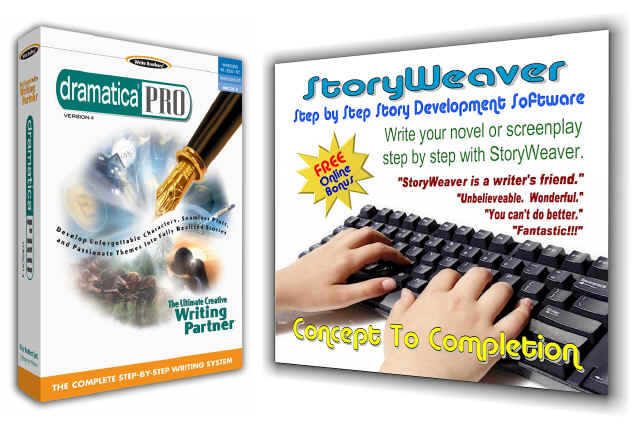
$179.95
$29.95
*Try either or both for 90 days. Not working for you?
Return for a full refund of your purchase price!
About Dramatica and
StoryWeaver
Hi, I'm Melanie Anne Phillips,
creator of StoryWeaver,
co-creator of Dramatica
and owner of Storymind.com. If you have a moment, I'd like to tell you
about these two story development tools - what each is designed to do, how
each works alone on a different part of story development and how they can be
used together to cover the entire process from concept to completion of your
novel or screenplay.
What They Do
Dramatica is a tool to help you
build a perfect story structure. StoryWeaver is a tool to help you build
your story's world. Dramatica focuses on the underlying logic of your
story, making sure there are no holes or inconsistencies. StoryWeaver
focuses on the creative process, boosting your inspiration and guiding it to add
depth, detail and passion to your story.
How They Do It
Dramatica has the world's only
patented interactive Story Engine™ which cross-references your answers to
questions about your dramatic intent, then finds any weaknesses in your
structure and even suggests the best ways to strengthen them.
StoryWeaver uses a revolutionary new
creative format as you follow more than 200 Story Cards™ step by step through
the story development process. You'll design the people who'll inhabit
your story's world, what happens to them, and what it all means.
How They Work
Together
By itself Dramatic appeals to
structural writers who like to work out all the details of their stories
logically before they write a word. By itself, StoryWeaver appeals to
intuitive writers who like to follow their Muse and develop their stories as
they go.
But, the finished work of a
structural writer can often lack passion, which is where StoryWeaver can help.
And the finished work of an intuitive writer can often lack direction, which is
where Dramatica can help.
So, while each kind of writer will
find one program or the other the most initially appealing, both kinds of
writers can benefit from both programs.
Try Both Programs
Risk Free!
We have a 90
Day Return Policy here at Storymind. Try either or both of these
products and if you aren't completely satisfied we'll cheerfully refund your
purchase price.
Our
Complete Catalog of Products
|

Get
the Writer's Survival Kit Bonus Package
FREE with ANY purchase!
A $300 Value!
|
|
StoryWeaver
- $29.95
Our
Bestseller! A
step by step approach to story development, from concept to completed
story for your novel or screenplay. More than 200 interactive
Story Cards guide you through the entire process.
|
|
Dramatica
Pro - $179.95
Includes
2 Exclusive Bonuses! The
most powerful story structuring software available, Dramatica is driven
by a patented "Story Engine" that cross-references your
dramatic choices to ensure a perfect structure.
|
 |
Dramatica
Writer's DreamKit - $49.95
Little
brother to Dramatica Pro, Writer's DreamKit is built around the same
patented Story Engine - it just tracks fewer story points. So, you
develop the same solid story structure, just with fewer details.
Perfect for beginning writers or those new to Dramatica.
|
 |
Power
Structure - $149.95
An
all-in-one writing environment with built-in word processor that helps
you organize and cross-reference your story development materials.
INCLUDES DVD SET BONUS!
|
|

|
Power
Writer - $99.95
The little
brother of Power Structure includes the essential organization and word
processing tools writers need the most.
|
 |
Throughline
- Index Cards (Mac) - $19.95
Interactive
index cards - add notes, titles, colors, click and drag to re-arrange.
An essential tool for every writer.
|
|
Movie
Magic Screenwriter - $149.95
The most
advanced screenwriting software available, Movie Magic is deemed a
"preferred file format" by the Writer's Guild. An
industry standard, MMS is used by professionals and studios around the
world.
|
|

|
Final
Draft - $199.95
Like Movie
Magic Screenwriter, Final Draft is an industry standard, used by many
professional screenwriters and studios around the world.
|
 |
Between
The Lines (Macintosh) - $29.95
The lowest
cost automatic screenplay formatter for Macintosh includes high-end
features such as interactive index cards linked to your script.
|
|

|
 |
12
Hour Writing Course - $19.95
Everything
you need to know about story structure - twelve hours of video on a
single DVD - presented by Dramatica Theory co-creator, Melanie Anne
Phillips.
|
 |
Dramatica
Software Companion - $19.95
More than
four hours of video demonstrations of every key feature in Dramatica,
narrated by the co-creator of Dramatica.
|
 |
StoryWeaving
Tips Book - $19.95
170 pages of
eye-opening essays on story structure, storytelling, finding inspiration
and a wide variety of writing techniques.
|
|
StoryWeaving
Seminar 8 DVD Set - $99.95
14 hours of
video from a live two day course taught by theory co-creator Melanie
Anne Phillips covering Dramatica story structure and StoryWeaver
storytelling.
|
|
StoryWeaving
Seminar Online - $49.95
The same 14
hour program presented in streaming video that you can view online or
download for a permanent copy.
|
|
Dramatica
Theory 2 Hour Audio Program - $19.95
Every key
concept in the Dramatica Theory of Story is fully explained in this
double-CD set.
|
|

|
Writing
Characters of the Opposite Sex - $29.95
A three-hour
audio CD set that explains everything you need to know to create
characters of both sexes that ring absolutely true (and maybe even gain
insight into the communication problems in the real world!)
|
 |
Master
Storyteller Improves Your Writing - $29.95
Become a
better writing with this series of interactive exercises.
|
|

|
How
to Create Great Characters DVD - $19.95
A 90 minute
video program recorded during Dramatica co-creator Melanie Anne
Phillips' live in-person seminar on story structure and storytelling.
|
|

|
Structure
vs. Passion - Audio CD $19.95
The Story
Mind approach to writing uses your own passions to create your story's
structure. It focuses your efforts, clarifies the direction of
your story, and triggers your imagination.
|
|

|
Writing
with the Story Mind - Audio CD - $19.95
Learn how to
psychoanalyze your story's "mind" to uncover and treat
problems with characters, plot, theme, and genre.
|
|

|
|
|
Academic
Prices - Discounts on Select Products
Are you a
student, teacher, or academic staffer? Get the very best price on
select products with these manufacturer sponsored academic discounts!
|
|

|
Package
Deals - Starting at $49.95
Get deep
discounts with these bundles of our most popular writing products.
|
|

|
Writer's
Survival Kit Bonus Package - FREE!
Free with
ANY purchase - Writing software, online writing workshops, writing
seminars on video, story theory book, and much, MUCH more!
|
| |
|














 Format:
Windows / Mac CD-ROM
Format:
Windows / Mac CD-ROM
