|
|
Software |
StoryWeaver
$29.95

A step by
step approach to story development, from concept to completed story for
your novel or screenplay. More than 200 interactive Story Cards guide
you through the entire process.
Details
and Demo
Dramatica
$149.95

The most
powerful story structuring software available, Dramatica is driven by a
patented "Story Engine" that cross-references your dramatic
choices to ensure a perfect structure.
Details
and Demo
Movie
Magic Screenwriter
$149.95

The most
advanced screenwriting software available, Movie Magic is deemed a
"preferred file format" by the Writer's Guild. An industry
standard, MMS is used by professionals and studios around the world.
Details
and Demo
Throughline
Index Cards
$9.95
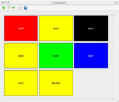
Interactive
index cards - Name them, add notes, titles, colors, click and drag to
re-arrange, adjust font, save, export and print. An essential tool for
every writer.
Details
Academic
Discounts
on Select Products

Are you a
student, teacher, or academic staffer? Get the very best price on select
products with these manufacturer sponsored academic discounts!
Details

|
| |
Chapter 28
Storytelling
&
Encoding Subjective Characters
Although authors use Subjective Characters all the time they unfortunately view the
Subjective functions simply as other aspects of Objective Characters. In fact, the two
functions are most often blended into a single concept of character that does double-duty.
This is dangerous since every aspect of the argument must be made twice: once Objectively
and once Subjectively. If both roles are blended, this can appear redundant. As a result,
important points in the separate arguments may be missing. In a temporal medium such as
motion pictures, it is often the Subjective argument that suffers as the focus is on more
objective action. In novels, the Objective Story is often flawed as the spatial nature of
a book favors the Subjective view.
Just because a medium favors one view over the other does not mean anything can be
neglected. All parts of both arguments must be present in order to create an effective
synthesis in the mind of the audience regardless of the emphasis a medium may place on
each view.
The Main Character is Not Necessarily the Protagonist
Many authors are not aware that a Protagonist does not have to be the Main Character.
When we stop to think about it, many examples come to mind of stories in which we
experience the story through the eyes of a character other than a Protagonist. Yet when it
comes to writing our own stories, many of us never diverge from a Protagonist/Main
combination.
There is nothing wrong with this combination. In fact, as long as both characters are
represented in the single player, such a blend is a fine Archetypal Character. The point
is: there are other ways.
Subjective Characters range from the Main Character with whom we identify to all the
"other soldiers in the trenches" around us as we experience the battle together.
They are friends and foes, mentors and acolytes. We see in them characteristics of Worry,
Instinct, Experience and Doubt. Rather than functioning as approaches the way the
Objective Characters appear to do, the Subjective Characters function as attitudes.
"We're Both Alike, You and I..."
The Main and Obstacle Characters are counterparts. They represent the two principal
sides to the argument of the story. Because they are dealing with the same issues a case
can be made that they are not too far apart. This often results in such familiar lines as
"We're both alike," "We're just two sides of the same coin," "I'm
your shadow self," and so on. In contrast, though they are concerned with the same
things, they are coming at them from completely opposing views. This leads to common line
such as "We're nothing alike, you and I," or "We used to be friends until
you stepped over the line."
Evil Twins?
Many authors picture the Obstacle Character as a negative or evil twin. Although this
can be true, it has little to do with the Obstacle Character's dramatic function. For
example, if a Main Character is evil and needs to change, their Obstacle might be a
virtuous steadfast character. Or both characters might be evil, with the resolve of
one contrasting the change in the other. In any case, the function of the Main and
Obstacle Characters is to show two opposing sides of the same issue. That is their story
function: to show what happens when one changes and the other remains steadfast on a
particular issue.
Encoding Mental Sex
Both Males and Females use the same techniques, but in different contexts. As a result,
what is problem solving for one may actually be justification for the other. In fact, for
the four perspectives in any given story, in one Domain both male and female mental sex
characters will see a given approach as problem solving, while in another Domain both will
see it as justification. The third Domain would be problem solving for one mental sex and
justification for the other and the fourth just the reverse.
Men TEND to use linear problem solving as their first method of choice. In linear problem
solving, they set a specific goal, determine the steps necessary to achieve that goal, and
embark on the effort to accomplish those steps. Gathering facts, or successfully achieving
requirements all deal with seeing a number of definable items that must be brought
together to make the mechanism work in the desired manner.
This is a very spatial view of problem solving, as it sees all the parts that must be
accomplished and/or brought together to resolve the problem or achieve the goal.
Women TEND to use holistic problem solving as their first method of choice. In holistic
problem solving, steps are not important and there may not even be a specific goal to
achieve but simply a new direction desired. As a result, the RELATIONSHIPS BETWEEN things
are what is measured and adjusted to create a change in the forces that determine that
direction. Unlike male problem solving, there is no causal relationship stating that THIS
leads to THAT. Instead, COMBINATIONS of changes in the way things are related alters the
dynamics of the situation rather than the structure, and changes context rather than
meaning.
This is a very temporal view of problem solving, as it looks at the way things are going
and tries to alter relationships so that the direction of the forces that create the
problem is deflected.
Now, men and women use both techniques. Also, women may become trained to use the linear
method first, and men may develop a preference for the holistic method as their primary
problem solving approach. These are preferences made through conscious choice, training,
or experience. Underneath it all, the brain's operating system for problem solving will
either be linear or holistic. This is what sets men and women apart from each other. No
matter how much common ground they come to from training, experience and conscious choice,
there is always that underlying level in which they can never see eye to eye, because they
have intrinsically different outlooks.
So, when choosing male or female mental sex, we are not concerned with the up front and
obvious, we are concerned with that hidden level at the foundation of the Main Character's
psyche that dictates a linear or holistic approach to the problem regardless of what is
done consciously.
That's why the issue becomes vague - because it is not cut and dried in the Main Character
nor is it up front. It is just their tendency at the lowest most basic part of their mind
to go linear or holistic.
How can we illustrate this in a Main Character? The following point by point comparison
can help:

As we can see, though both men and women will use both techniques depending on context,
one kind comes first or takes priority. Which one is the principal technique is determined
by mental sex. So, if you keep in mind that this all may be overshadowed by other learned
techniques, you can illustrate male and female problem solving techniques as a TENDENCY to
employ those listed above, all other things being equal.
Building a Mind for the Audience to Possess
When an audience looks at the Objective Characters, they see the Story Mind from the
outside in. When an audience empathizes with the Main Character, they see the story from
the inside out. In order for the audience to be able to step into the shoes of the Main
Character and look through his eyes, he must possess a complete mind for the audience to
possess. And that perhaps is the best way to look at it: the audience takes possession of
the Main Character's mind. That's why you hear people in a movie yelling, "NO....
don't do that!!!" to a Main Character who is about to enter the shed where the
slasher is waiting.
However, the question arises: who is taking possession of whom? As authors we direct our
Main Character to take control of the audience's hearts and souls. We make them feel what
the Main Character feels, experience what he experiences. It's a pretty sinister
occupation we engage in. But that is how a story stops being a spectacle and worms its way
into the heart.
Proceed
to the Next Section of the Book-->
How to Order Dramatica:
A New Theory of Story
Back to
the Table of Contents
Back to the Dramatica Home Page
Copyright 1996, Screenplay Systems, Inc.
The Dramatica theory was developed by Melanie Anne Phillips and Chris Huntley
Chief Architect of the Dramatica software is Stephen
Greenfield
Dramatica is a registered trademark of Screenplay Systems Incorporated
Visit
the Dramatica Theory Home Page
Try Dramatica & StoryWeaver Risk
Free*
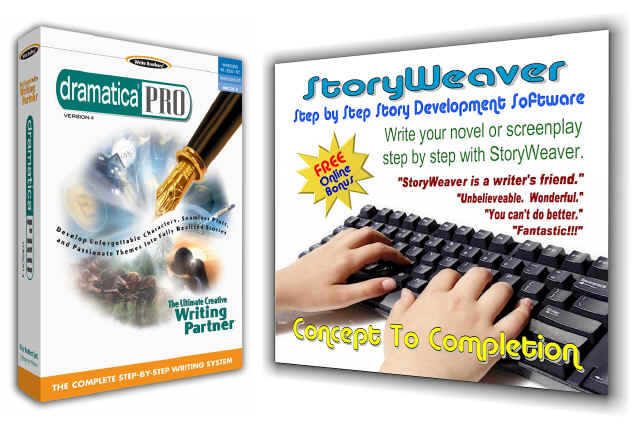
$179.95
$29.95
*Try either or both for 90 days. Not working for you?
Return for a full refund of your purchase price!
About Dramatica and
StoryWeaver
Hi, I'm Melanie Anne Phillips,
creator of StoryWeaver,
co-creator of Dramatica
and owner of Storymind.com. If you have a moment, I'd like to tell you
about these two story development tools - what each is designed to do, how
each works alone on a different part of story development and how they can be
used together to cover the entire process from concept to completion of your
novel or screenplay.
What They Do
Dramatica is a tool to help you
build a perfect story structure. StoryWeaver is a tool to help you build
your story's world. Dramatica focuses on the underlying logic of your
story, making sure there are no holes or inconsistencies. StoryWeaver
focuses on the creative process, boosting your inspiration and guiding it to add
depth, detail and passion to your story.
How They Do It
Dramatica has the world's only
patented interactive Story Engine™ which cross-references your answers to
questions about your dramatic intent, then finds any weaknesses in your
structure and even suggests the best ways to strengthen them.
StoryWeaver uses a revolutionary new
creative format as you follow more than 200 Story Cards™ step by step through
the story development process. You'll design the people who'll inhabit
your story's world, what happens to them, and what it all means.
How They Work
Together
By itself Dramatic appeals to
structural writers who like to work out all the details of their stories
logically before they write a word. By itself, StoryWeaver appeals to
intuitive writers who like to follow their Muse and develop their stories as
they go.
But, the finished work of a
structural writer can often lack passion, which is where StoryWeaver can help.
And the finished work of an intuitive writer can often lack direction, which is
where Dramatica can help.
So, while each kind of writer will
find one program or the other the most initially appealing, both kinds of
writers can benefit from both programs.
Try Both Programs
Risk Free!
We have a 90
Day Return Policy here at Storymind. Try either or both of these
products and if you aren't completely satisfied we'll cheerfully refund your
purchase price.
Our
Complete Catalog of Products
|

Get
the Writer's Survival Kit Bonus Package
FREE with ANY purchase!
A $300 Value!
|
|
StoryWeaver
- $29.95
Our
Bestseller! A
step by step approach to story development, from concept to completed
story for your novel or screenplay. More than 200 interactive
Story Cards guide you through the entire process.
|
|
Dramatica
Pro - $179.95
Includes
2 Exclusive Bonuses! The
most powerful story structuring software available, Dramatica is driven
by a patented "Story Engine" that cross-references your
dramatic choices to ensure a perfect structure.
|
 |
Dramatica
Writer's DreamKit - $49.95
Little
brother to Dramatica Pro, Writer's DreamKit is built around the same
patented Story Engine - it just tracks fewer story points. So, you
develop the same solid story structure, just with fewer details.
Perfect for beginning writers or those new to Dramatica.
|
 |
Power
Structure - $149.95
An
all-in-one writing environment with built-in word processor that helps
you organize and cross-reference your story development materials.
INCLUDES DVD SET BONUS!
|
|

|
Power
Writer - $99.95
The little
brother of Power Structure includes the essential organization and word
processing tools writers need the most.
|
 |
Throughline
- Index Cards (Mac) - $19.95
Interactive
index cards - add notes, titles, colors, click and drag to re-arrange.
An essential tool for every writer.
|
|
Movie
Magic Screenwriter - $149.95
The most
advanced screenwriting software available, Movie Magic is deemed a
"preferred file format" by the Writer's Guild. An
industry standard, MMS is used by professionals and studios around the
world.
|
|

|
Final
Draft - $199.95
Like Movie
Magic Screenwriter, Final Draft is an industry standard, used by many
professional screenwriters and studios around the world.
|
 |
Between
The Lines (Macintosh) - $29.95
The lowest
cost automatic screenplay formatter for Macintosh includes high-end
features such as interactive index cards linked to your script.
|
|

|
 |
12
Hour Writing Course - $19.95
Everything
you need to know about story structure - twelve hours of video on a
single DVD - presented by Dramatica Theory co-creator, Melanie Anne
Phillips.
|
 |
Dramatica
Software Companion - $19.95
More than
four hours of video demonstrations of every key feature in Dramatica,
narrated by the co-creator of Dramatica.
|
 |
StoryWeaving
Tips Book - $19.95
170 pages of
eye-opening essays on story structure, storytelling, finding inspiration
and a wide variety of writing techniques.
|
|
StoryWeaving
Seminar 8 DVD Set - $99.95
14 hours of
video from a live two day course taught by theory co-creator Melanie
Anne Phillips covering Dramatica story structure and StoryWeaver
storytelling.
|
|
StoryWeaving
Seminar Online - $49.95
The same 14
hour program presented in streaming video that you can view online or
download for a permanent copy.
|
|
Dramatica
Theory 2 Hour Audio Program - $19.95
Every key
concept in the Dramatica Theory of Story is fully explained in this
double-CD set.
|
|

|
Writing
Characters of the Opposite Sex - $29.95
A three-hour
audio CD set that explains everything you need to know to create
characters of both sexes that ring absolutely true (and maybe even gain
insight into the communication problems in the real world!)
|
 |
Master
Storyteller Improves Your Writing - $29.95
Become a
better writing with this series of interactive exercises.
|
|

|
How
to Create Great Characters DVD - $19.95
A 90 minute
video program recorded during Dramatica co-creator Melanie Anne
Phillips' live in-person seminar on story structure and storytelling.
|
|

|
Structure
vs. Passion - Audio CD $19.95
The Story
Mind approach to writing uses your own passions to create your story's
structure. It focuses your efforts, clarifies the direction of
your story, and triggers your imagination.
|
|

|
Writing
with the Story Mind - Audio CD - $19.95
Learn how to
psychoanalyze your story's "mind" to uncover and treat
problems with characters, plot, theme, and genre.
|
|

|
|
|
Academic
Prices - Discounts on Select Products
Are you a
student, teacher, or academic staffer? Get the very best price on
select products with these manufacturer sponsored academic discounts!
|
|

|
Package
Deals - Starting at $49.95
Get deep
discounts with these bundles of our most popular writing products.
|
|

|
Writer's
Survival Kit Bonus Package - FREE!
Free with
ANY purchase - Writing software, online writing workshops, writing
seminars on video, story theory book, and much, MUCH more!
|
| |
|











 Format:
Windows / Mac CD-ROM
Format:
Windows / Mac CD-ROM
