Storymind.com Writing Tips & Writing Software
 

Screenwriting Software

Books and Videos on Writing

Writing with the Story Mind<br>1 hour audio program
Dramatica &
Accessories


Software

 
StoryWeaver

$29.95

A step by step approach to story development, from concept to completed story for your novel or screenplay. More than 200 interactive Story Cards guide you through the entire process.

Details and Demo


Dramatica

$149.95

Dramatica Pro 4.0<br>Plus FREE Bonus!

The most powerful story structuring software available, Dramatica is driven by a patented "Story Engine" that cross-references your dramatic choices to ensure a perfect structure.

Details and Demo


Movie Magic Screenwriter

$149.95

Movie Magic Screenwriter<br>Plus FREE Bonus!

The most advanced screenwriting software available, Movie Magic is deemed a "preferred file format" by the Writer's Guild. An industry standard, MMS is used by professionals and studios around the world.

Details and Demo


Throughline Index Cards

$9.95

Interactive index cards - Name them, add notes, titles, colors, click and drag to re-arrange, adjust font, save, export and print. An essential tool for every writer.

Details


Academic Discounts
on Select Products

Are you a student, teacher, or academic staffer? Get the very best price on select products with these manufacturer sponsored academic discounts!

Details


Dramatica Weekend Workshop Syllabus

6 PLOT

Plot versus Storyweaving

The plot of a story describes the internal logic or sequence of events that lead the characters from their situations and attitudes at the beginning of the problem to their situations and attitudes when the effort to solve the problem is finally over. Once that has been established, an author may choose to rearrange the order in which those events are revealed to the audience. This rearrangement may be integral to the feel of the finished work, but has no effect on the internal logic as determined by the storyform. As a result, such a technique falls into the realm of storytelling. In Dramatica, storytelling techniques of this nature are called storyweaving.

Plot affects all parts of story:


Character growth

Theme progression

Genre development


Static Vs. Progressive Appreciations

Static Plot Appreciations

There are Objective Story Throughline appreciations, Main Character appreciations, Obstacle Character appreciations and Subjective Story Throughline appreciations. There are even appreciations that are the synthesis of all four points of view such as Goal, Requirements, and Consequences. These central appreciations seem the most plot-like because they affect the Concerns of all four throughlines. As varied as all of these appreciations are, there is one quality they share: they stay the same from the beginning to the end of a story. Appreciations of this stable nature are called Static Appreciations.

• Goal: The story goal describes a specific item that is a shared concern. The item being sought after or seeking to avoid.

* Video Clips: Montage of stories whose goal is “Obtaining.”: Raiders of the Lost Ark, Body Heat, The Searchers, Rain Man, Ace Ventura, Ruthless People, Unforgiven.

* Video Clips: Montage of stories with differing goals: Lawrence of Arabia (Learning), Dave (Being), An Officer and a Gentleman (Becoming), Back to the Future (Future).

* Video Clips: Comparison of goals between Casablanca (Obtaining) and The Godfather (Obtaining).

• Consequences: The results of failing to achieve the Goal.

* Video Clips: Comparison of consequences between Casablanca (Becoming) and The Godfather (Becoming).

• Requirement: The steps needed to taken or conditions needed to be met to reach the Goal.

* Video Clips: Comparison of requirements between Casablanca (Understanding) and The Godfather (Doing).

• Forewarnings: The foreshadowing events that indicate the approach of the consequences.

* Video Clips: Comparison of forewarnings between Casablanca (Memory) and The Godfather (Progress).

• Prerequisites: The steps necessary to get the requirements accomplished.

* Video Clips: Comparison of prerequisites between Casablanca (Conceptualizing) and The Godfather (Being).

• Preconditions: Conditions imposed on meeting the requirement.

* Video Clips: Comparison of preconditions between Casablanca (The Past) and The Godfather (The Preconscious).

• Costs: The price to pay on the way to the Goal. Every time a character endures some displeasure as a result of trying to achieve the goal, this additional price is a Cost.

* Video Clips: Comparison of costs between Casablanca (The Future) and The Godfather (Subconscious).

• Dividends: During the effort to achieve the goal, certain benefits are enjoyed or accrued along the way. These serve to add motivation for the characters to continue.

* Video Clips: Comparison of dividends between Casablanca (Subconscious) and The Godfather (The Future).


Progressive Plot Appreciations


Progressive plot appreciations change their nature over the course of the story. They are Acts, Sequences, Scenes, and Events. Events are nested in Scenes which are nested in Sequences which are nested in Acts. The Progressive Appreciations tell us how a story unfolds.

• 3 Acts Vs. 4 Acts

4 Act Plot: Each Class in the Thematic Structure has four Types in the level just below the Class. Each Type in a throughline will be the subject matter of one of four Acts in that throughline. The order in which the Types are explored determines the Progressive meaning of that throughline’s evolution.

3 Act Plot: Some two thousand years ago, Aristotle proposed that every functional plot should have a beginning, a middle, and an end. Since that time, this notion has evolved into a widely held view that there should be three Acts in a complete story. Act one sets up the dramatic potentials. Act two plays these potentials against each other. Act three describes how it all turned out.

• Signposts and Journeys

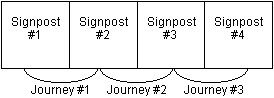
At first, a three act progression might seem in conflict with Dramatica’s four act view. The two actually go hand in hand.

Act 1 Act 2 Act 3 Act 4

The illustration above shows how a plot that covers four different Acts (designated as signposts) will automatically generate three different transitions (called journeys) as the subject matter shifts from one concern to the next. When Aristotle saw a beginning, middle and end, he was seeing Signpost 1, all three journeys lumped together, and Signpost 4. When successive generations of writers evolved a three act structure, it became very difficult to determine, “What happens in Act 2*” as all three journeys and two of the signposts were simply blended into “the middle”. By adopting a Four Act structure which coincides with three dynamic acts, the true nature of a throughline’s plot is far easier to understand and construct.


Plot Act Order Examples

Objective Story throughline act order for The Godfather.

* Video Clip: Act 1 -- Understanding.

* Video Clip: Act 2 -- Obtaining.

* Video Clip: Act 3 -- Learning.

* Video Clip: Act 4 -- Doing.

Obstacle Character (Obi Wan) throughline act order for Star Wars.

* Video Clip: Act 1 -- Conscious.

* Video Clip: Act 2 -- Preconscious.

* Video Clip: Act 3 -- Memory.

* Video Clip: Act 4 -- Subconscious.

Back to the Dramatica Weekend Workshop
Table of Contents

[dramatica/dramatica_footer.htm] 

Resources

 
Articles

Video/Audio

Downloads

Subscribe to Storymind Writing Tips Newsletter


Articles

Most Popular

Characters

Plot

Theme

Genre

Creative Writing

Constructive Criticisms

The Story Mind

Story Points

Propaganda

Reception

Story Development

Story Structure

Dramatica Theory

Dramatica Software


Video/Audio

The Story Mind

Characters

Plot

Theme

Genre

Storyforming

Story Ecoding

Storyweaving

Reception


Downloads

Story Structure eBook

4 Hour Audio Program
on Story Sructure

StoryformingNewsletter

Story Struicture inThe Real World eBook

eBooks, Guides

Demos & Trials

Subscribe to Storymind Writing Tips Newsletter
 

Contact Us - About Us - Lowest Price Guarantee - Shipping - Return Policy

Copyright Melanie Anne Phillips - Owner, Storymind.com, Creator Storyweaver, Co-creator Dramatica